
Every retailer knows the pain of online customer service gone wrong: an inbox overflowing with tickets, customers chasing order updates, and your team scrambling to keep up. And we all know that the shopper frustrations caused by poor service lead to lost sales and reduced loyalty towards the brand.
That’s what Klaviyo has set out to change with K:Service, their latest innovation designed to bring customer support via self service, an AI-assisted agent, or dedicated human response & management to Shopify retailers. Imagine adding a personalised service layer to your website that recognises the customer, knows their order history, can recommend products, will help with order updates or returns, and even surfaces loyalty points and unique offers… A world of difference compared to a contact form to request a return, or seeing a generic live chat greeting.
In the latest episode of the CTD Roundtable, we spoke with Ben Panther and Caster Calma from Klaviyo, who joined Glenn & Marty from Connect the Dots to unpack what this new offering really means for Shopify merchants. We were lucky enough to get an insider’s view on the thinking behind the Customer Hub, Customer (AI) Agent, and Helpdesk, and how they’re helping retailers deliver faster, smarter, and more personalised experiences without adding complexity.
From what we saw, K:Service is a key component in closing the gap between online and in-store customer service. In the short term it’s set to support customer acquisition, conversion rates, and loyalty, while long term we’re expecting that shoppers will come to see this level of improved service as the new benchmark, and sites that don’t offer it risk losing out.
Does K:Service sound like something you want to understand more and make the call on for your business? Keep reading for the full overview, or click here to talk to our team.
Customer service has long been treated as a separate system or set of channels that are disconnected from marketing. That fragmentation costs time and makes personalised responses difficult when information is siloed or the history or multichannel actions is missing. These two functions should inform one another if you’re wanting to generate more efficient outcomes in both areas of your business, and that’s what K:Service will help you unlock.
As Ben Panther, Klaviyo’s Partner Account Manager, explained during our recent conversation:
“K:Service is the final piece of the customer lifecycle puzzle. It connects acquisition, retention, and support into a single ecosystem, so every interaction feels personal, relevant, and fast.”
K:Service delivers that integration through three core components:
The result is an end-to-end experience that works for customers and the teams who serve them.
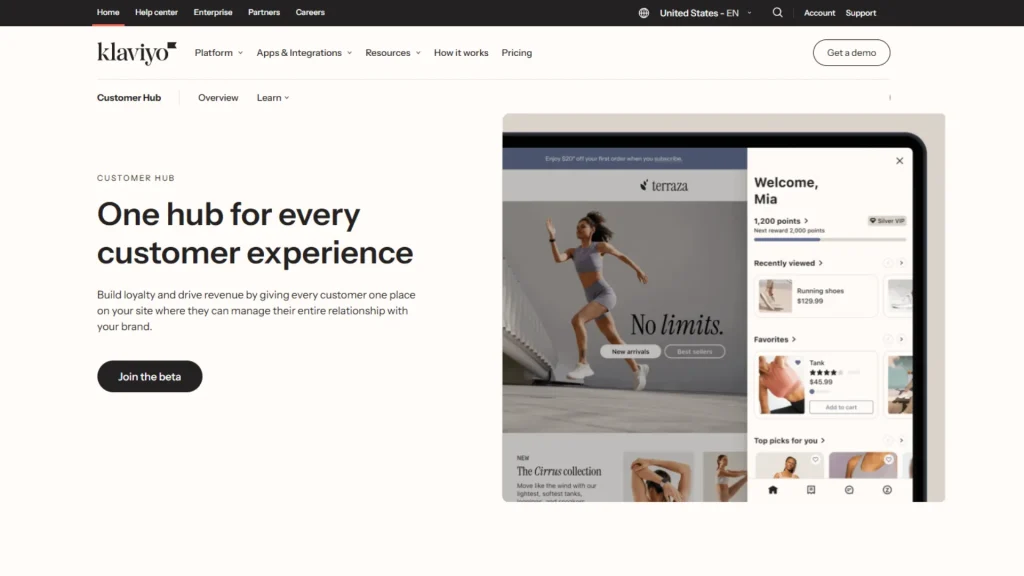
Think of the Customer Hub as a living, breathing version of your My Account page that also acts as a single place where customers can see and manage everything: first order discounts, past orders, tracking details, returns, loyalty rewards, and even personalised win-back offers. It’s all powered by Klaviyo data, so every view is tailored to that specific customer.
“It’s the digital version of walking into your favourite store and being recognised by name. There’s no friction, no hunting for details. Just service that feels personal.” – Marty Jenkins-Lyttle, Connect the Dots
For merchants, the benefit is immediate. Self-service reduces the number of support tickets while deepening loyalty through smoother, more transparent experiences.
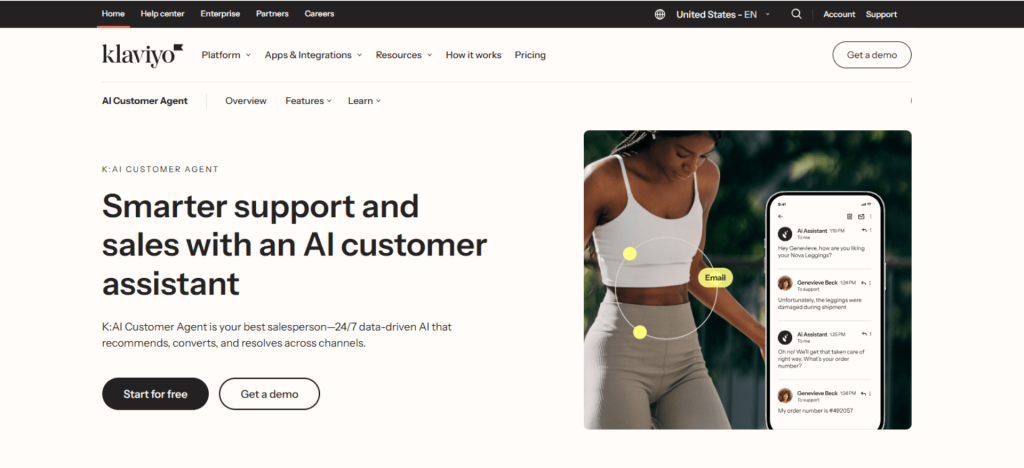
The Customer Agent brings real-time intelligence to customer service. It’s trained on your products, your tone of voice, and your customer data. Instead of giving generic chatbot replies, it can handle practical questions like:
And it can take action to process returns, recommend alternatives, or even close a sale directly from chat.
Caster Calma, our Partner Account Manager from Klaviyo highlighted how the agent bridges automation and empathy:
“It’s not about replacing people, it’s about freeing them. The AI Agent handles routine questions, so your team can focus on complex issues that build relationships.”
What makes it so powerful is the context. The AI Agent recognises customers, can work from their history with your business, and then serves them accordingly. There’s no need to repeat order numbers or start again for every request. If it ever falls short of an answer it’ll divert back to a human for help, then you can train it on what to do in future.
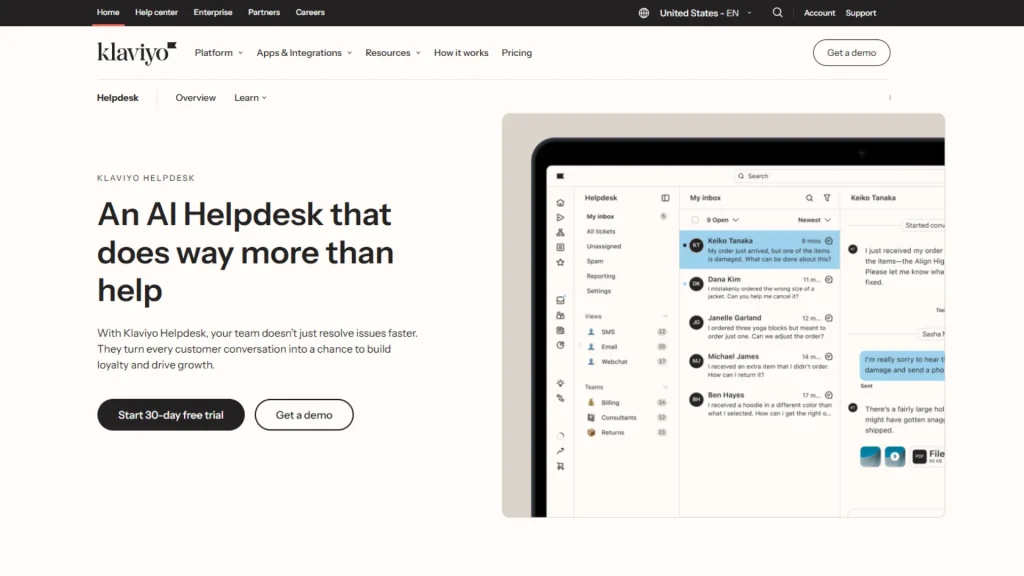
The Helpdesk is where everything connects. It pulls conversations from a range of channels into one clean interface. When a customer reaches out, your team instantly sees their purchase history, loyalty tier, previous messages, and service interactions all in one place.
That visibility allows teams to respond faster and with more context. No switching tabs, no digging through process docs or logging into additional channels, and no fragmented service experience for the customers.
Early adopters report shorter response times, lower costs, and happier teams. As Ben put it,
“It’s the first time support staff can see the full picture: who the customer is, what they’ve bought, and how they’ve interacted with the brand. All on one screen.”
For Shopify merchants, K:Service is remarkably easy to activate. Most can set up and launch within a single day and explore all features through a free trial.
Once live, the benefits compound quickly. Because K:Service syncs with your existing Klaviyo data, you can:
As Caster noted, every service interaction becomes a revenue opportunity. Instead of viewing support as a cost centre, K:Service turns it into a revenue and retention engine.
It sounds great, but what does it cost? K:Service is designed to grow with your business. Pricing is based on usage, so small teams can start affordably while larger retailers scale with confidence.
For early adopters, Klaviyo is offering promotional pricing until the end of the 2025 calendar year, a good chance to investigate and capitalise ahead of the peak retail season.
Customer expectations have changed. Fast shipping and smooth checkouts are now standard. The next frontier is intelligent, proactive service. The kind that anticipates needs before customers have to ask.
K:Service bridges that gap. It’s not another app or layer on site. It’s the evolution of how ecommerce brands serve customer needs and build loyalty. The merchants who embrace it now will set the tone for what great online retail feels like in 2026 and beyond.
Ready to see it in action? Already a Klaviyo user? Explore Klaviyo’s Customer Service Solutions and start your free trial from inside your account today.
New to Klaviyo? Learn more about Klaviyo’s Customer Service Solutions here.
Want to talk more about how you can utilise the new K:Service offerings in your business? Get in touch with your Connect the Dots consultant or with our team to understand what Customer Hub, Customer Agent, and Helpdesk can do for your business.
Ben explains that service is an area that hasn’t shifted much in years, until AI came along. Klaviyo saw the gap & built KService to close it, giving brands a way to handle self-service, always-on support, & human help desk without needing four or five bolted-together apps.
For Glenn & Marty, the significance is less about the tech itself & more about what it signals. Data utilisation has always been Klaviyo’s quiet strength. Service is what finally turns that into something customers feel directly.
Ben walks through Klaviyo’s shift earlier in the year from a marketing & email platform to a true CRM. Full life cycle means covering acquisition, retention, & sales, but also what happens when a customer has a problem. Until now, that last part sat outside the platform entirely.
Caster adds that this is what finally gives Klaviyo genuine CRM credentials. It’s no longer just about how you reach a customer through email or SMS, it’s about understanding who they are & how you support them once they’ve bought.
Ben breaks KService into three parts. Customer Hub replaces the standard Shopify account page with a personalised hub. AI agent handles round-the-clock support across web chat, SMS, & email. Help desk brings human agents into the platform, backed by all the customer data already sitting in Klaviyo.
The point Marty makes is that none of this is all-or-nothing. A brand can lean into self-service, add AI support, or plug in an existing service team, without giving up control of any one piece.
Ben demos it live on a Shopify store. Customers land on a “for you” page with personalised coupons, recently viewed items, favourites, & top picks based on their own behaviour. Add something to a wishlist & it becomes usable data for flows & emails straight away.
Order tracking sits in the same place, pulling live status from Shopify & even prompting a return without needing an email exchange. Marty’s read on it: this closes the gap between the in-store experience of being recognised & the online one, & it’s the difference customers actually notice.
Glenn asks the practical question a lot of business owners will have. Caster confirms customers don’t need a Shopify account for Customer Hub to recognise them. As long as they’ve opted into email marketing, Klaviyo ties that activity back to their profile.
Ben’s summary: it’s smart enough to know you’ve been on the site before, account or not, & start personalising what it shows you from there.
Ben shows the AI agent answering product questions & driving a sale directly from the chat window, with revenue attributed back in Klaviyo. Ask to speak to a person & it hands off cleanly to help desk or a third-party tool like Gorgias or Zendesk.
Marty’s take is that this positioning is the smart part. It’s not a full replacement for a service team, & it’s not just deflection either. It can sell, which makes the ROI conversation with clients a lot easier than talking about ticket reduction alone.
Ben covers the channels: email, SMS, web chat, WhatsApp, & Instagram DMs, with more on the way. Message a brand on WhatsApp & help desk matches the number straight to a Klaviyo profile, so the order history & context are there before the conversation even starts.
Caster frames this as the bit customers actually feel. No repeating yourself to a new person every time you reach out. That continuity is what separates brands using KService from the ones still starting from scratch on every ticket.
Caster’s view is blunt: brands that don’t test this now risk being left behind, because customers want to be remembered & will go elsewhere if they’re not. Glenn draws the parallel to Amazon’s overnight delivery era, & to the shift from paper forms to web forms before that.
Marty’s angle: initially it’s a bump in conversion & average order value. Longer term, not having it is what costs you, because customers simply expect it once they’ve experienced it once.
Ben’s answer will surprise a few people: Customer Hub is roughly a one-day setup job, with most of the time actually spent on design & content blocks rather than the technical build. AI agent takes about the same to index a site & get running, with a tone-of-voice editor & knowledge-gap detection coming in Q4.
Marty frames the deploy itself as the easy part. The real work, & the fun part for marketers, is everything you build off the back of the data once it’s live: new flows, win-back journeys, & segmentation you couldn’t do before.
Ben explains the three products are priced separately. Customer Hub sits around 10% of your existing Klaviyo email plan, roughly $80 to $200 NZD a month depending on brand size. AI agent is priced per resolved conversation, & help desk per ticket, similar to Gorgias or Zendesk.
Every product comes with a 30-day free trial, & an early adopter discount for anyone signing up before year end locks in that pricing for as long as they stay on the product. Glenn calls it a genius move, making this accessible regardless of business size.
KService is a genuine shift in what a Klaviyo & Shopify site can do for a customer after the sale. It’s quick to deploy, doesn’t require an all-or-nothing commitment, & the businesses that test it now will set the bar their competitors get judged against. The ones that wait will be the ones playing catch-up on customer expectations they didn’t see coming.
Glenn Marvin, Connect the Dots
Marty Jenkins-Lyttle, Connect the Dots & Caster Kelma, Ben Panther, Klaviyo
6 minutes
Join the ranks of ambitious leaders unlocking new heights in business growth. Book a discovery call today.