CTD Roundtable | Being Found in the Era of LLMs: New Visibility Rules for Every Business

Introduction: Why AI is the New Gatekeeper

There’s a new gatekeeper standing between your business and your next customer, and it’s not a search algorithm you can trick with keywords. It’s a large language model, and it’s forming opinions about your brand right now, with or without your input.

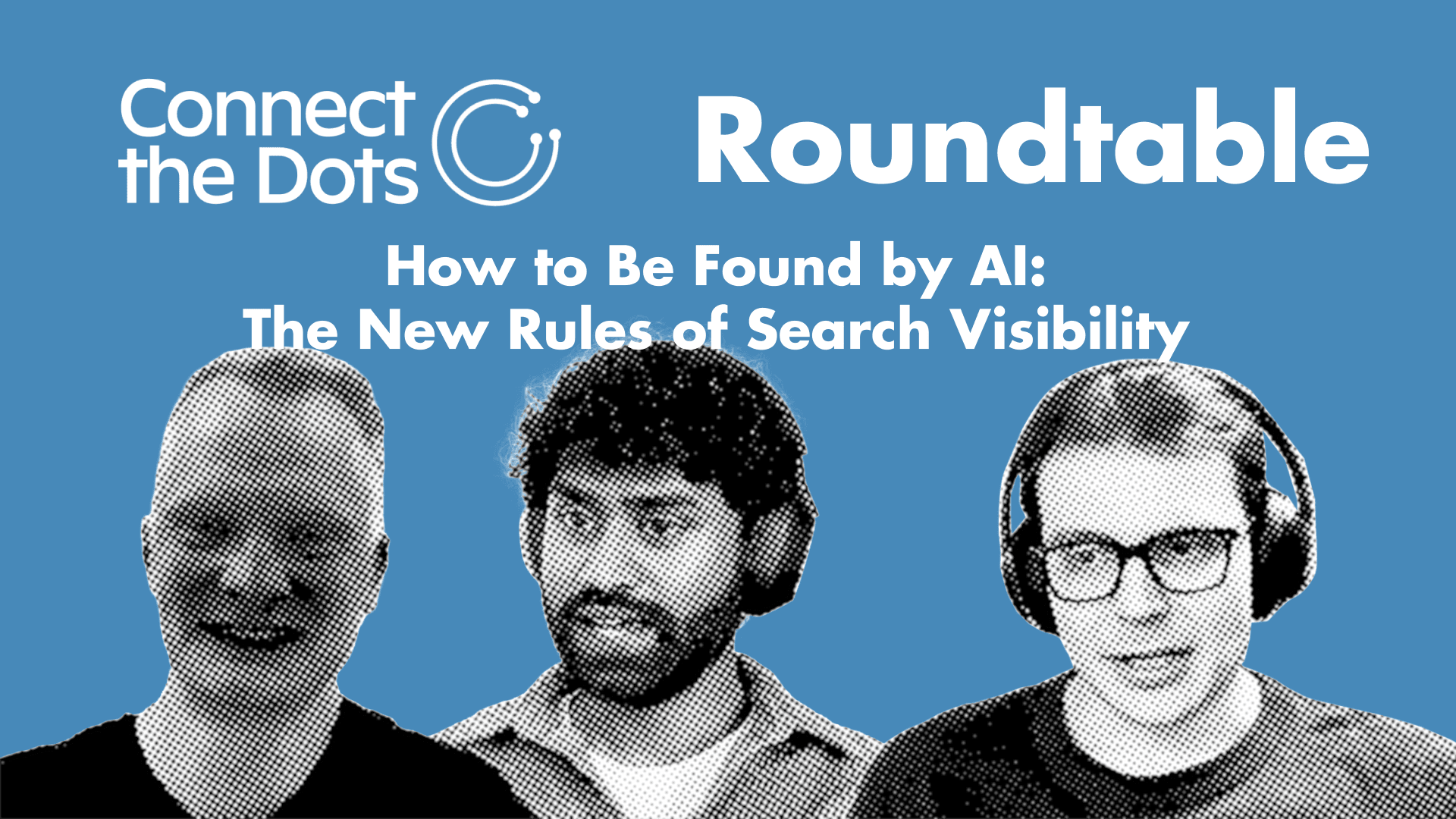
In this episode of the CTD Roundtable, Marty sits down with Derrick and Misha, co-founders of the New Zealand-based startup AuraScope, to unpack the new rules of being found in the era of LLMs and the rise of Answer Engine Optimisation (AEO).

If you’re a business owner, marketer, or growth strategist wondering whether AI search is just hype or a real channel you need to invest in, this episode is the clearest and most practical breakdown you’ll find.

01 · SEO, AEO, GEO: What Do These Terms Actually Mean?


Before we dive into the mechanics of visibility, let’s define the three acronyms dominating the conversation right now. Understanding the distinction between SEO, AEO, and GEO is critical for any business looking to move from being just another ‘link’ to being cited as the ‘definitive answer.’

SEO, Search Engine Optimisation

The traditional practice of optimising websites and content to rank higher in Google’s results pages. Built on a keyword-ranking model where Google open-sourced its ranking criteria, SEO became a structured, if slow-moving, discipline over two decades. The lag between action and outcome can be months.

AEO, Answer Engine Optimisation

The emerging practice of optimising your brand to be the answer that AI-powered platforms return when users ask questions. AEO requires influencing the citations and sources that large language models draw from, earning mentions and ultimately recommendations. Derrick’s preferred term, because it accurately captures the goal: becoming the answer.

GEO, Generative Engine Optimisation

An alternative term for AEO. Derrick noted (with engineering pragmatism) that ‘generative engine’ is too broad, there are many generative engines, not all of which are AI chatbots. For practical purposes, GEO and AEO refer to the same discipline.

“You can be the top-ranked SEO company but if you don’t have the authority or the content or even the website’s readability from an AI perspective, you’re not gonna show up as the answer. And if you don’t, you’re invisible.” Derrick Edward, Co-founder, AuraScope
⚡ KEY STAT: An AI-referred website visitor is 5× more valuable than a standard organic search visitor,  because they arrive with significantly higher purchase intent, having already had their question answered and their options narrowed by the AI model before clicking through.

02 · Why AEO is a Fundamentally Different Discipline

One of the pushbacks Derrick and Misha frequently encounter comes from established SEO practitioners who argue that AEO is just SEO by another name. There are some commonalities, but historical success in SEO doesn’t guarantee a citation with ChatGPT, Gemini, or Perplexity.

Good SEO ≠ Good AEO (but it helps)

Good SEO is a prerequisite for good AEO, but it’s not sufficient on its own. The elements of traditional SEO that transfer across are those that improve AI readability, clear heading structures, schema markup, and well-organised page hierarchy. These allow AI crawlers to parse and understand your content.

However, keyword strategy, meta descriptions, and link-building for PageRank are largely irrelevant from an AI recommendation standpoint. An AI model doesn’t rank your website; it synthesises an answer from the sources it trusts most and includes or excludes you based on whether those sources reference your brand.

The E-A-T Framework Takes Centre Stage

In AEO, the E-A-T framework, Experience, Expertise, Authority, and Trust, becomes the dominant signal. AI models apply it rigorously, requiring that your brand demonstrates these qualities at a holistic level: not just on a single page, but across your entire digital footprint, third-party coverage, and the sources that AI systems trust.

The Attribution Problem

One of the most practically significant challenges in AEO is the near-impossibility of clean attribution. In traditional SEO, the path is often linear and trackable: impression → click → session → conversion. In AEO, AI often plants the seed of a buying decision without producing the crucial click for tracking to attribute from.

For example, a business owner asks ChatGPT which accounting software to use. ChatGPT recommends three options, including yours. The user mentally notes your brand, closes the chat, and later types your URL directly into their browser. Your analytics show a direct visit. The AI’s role is invisible, but it was the catalyst.

“AEO actually brings all of this together, it’s one collective thing. And this is where you need to think bigger and faster.” Misha Afon, Co-founder, AuraScope
💡 ANALOGY FROM THE EPISODE: AEO’s attribution is closer to traditional brand marketing, where a good brand presence can have a ‘halo effect’ that lifts performance across other channels. AI citation works similarly, where being recommended by ChatGPT or Gemini elevates your brand and drives downstream action, even when the click doesn’t follow immediately.

03 · Measuring What Matters: New Metrics for AI Visibility

We can’t think about “ranking” with ChatGPT like we do with Google in traditional SEO.Instead, marketers need a new measurement vocabulary when they’re working in this space. Here’s what Derrick and Misha recommend:

1. AI Visibility Score

A composite measure of how often your brand is mentioned across responses from ChatGPT, Gemini, and Perplexity, tracked across a prompt library aligned to your business category and buyer personas.

2. Share of Voice

Within any given AI response, multiple brands are typically recommended. Share of voice measures what percentage of responses include your brand versus competitors, the AI-native equivalent of category ownership.

3. Citations & Domains

The AI models cite sources when answering a question. These are the lifeblood of AI. If your brand appears in high-authority sources that AI trusts, your likelihood of being mentioned increases. Citations are the mechanism; mentions are the outcome.

4. Sentiment Analysis

Not just whether your brand appears, but how it is characterised. A brand consistently mentioned in the context of ‘affordable’ versus ‘premium’ is being shaped by AI, and that framing affects conversion. Monitoring sentiment allows brands to course-correct their positioning narrative.

04 · Inside the AuraScope Platform: A Live Demo with Woolworths NZ

The best way to understand more about what AuraScope can do is to see it in action. Misha and Derrick were good enough to demonstrate a live example using Woolworths New Zealand. 

AuraScope tracks three AI platforms: ChatGPT, Perplexity, and Gemini, chosen because they represent the largest volume of AI search traffic globally. Watch the full episode to see how quickly AuraScope set up and analysed Woolworths’ current presence in the local market.

The Prompt Library: Your Strategy Made Visible

One of AuraScope’s key differentiators is how it constructs the prompts it uses to measure your AI presence. Rather than asking businesses to guess what queries their customers are running, AuraScope builds a prompt library by combining three inputs: a detailed digital profile of the organisation, academic research on how people query AI models, and analysis of the competitive set and buyer personas.

In the Woolworths demo, a prompt like “How do I order groceries online for same-day delivery?” returned results that showed Woolworths was mentioned across all three AI platforms, but in different ways. 

  • ChatGPT introduced the brand with the qualifier ‘formerly Countdown’.
  • Perplexity surfaced Milkrun (a Woolworths subsidiary) as an alternative. 
  • Gemini also returned a positive citation for the brand.
“Prompts are effectively your strategy. They’re your window into the AI world.” Misha Afon, Co-founder, AuraScope

Actionable Recommendations, Not Just Dashboards

AuraScope’s most valuable feature is that it takes you beyond analysis and into a recommendation engine. Rather than presenting data and leaving users to infer what to do, the platform explains why each metric matters and prescribes specific actions.

For example, in the NZ supermarket category, product schema implementation correlates with a 39% increase in AI citations. The platform identifies which specific pages on the website would benefit most, explains the reasoning in plain language, and delivers implementation instructions in Markdown format, ready to hand to a developer or AI coding tool.

05 · The Brand Aura Framework: Five Pillars of AI Visibility

To give businesses a coherent framework for improving their AI presence, AuraScope developed an internal scoring model called Brand Aura. Each business is scored against 5 pillars.

Pillar 1: Page Structure

The foundational layer. If AI crawlers cannot parse your website’s hierarchy, none of the other pillars matter. This covers logical heading structures, clean URL formatting, and a navigation schema that makes site content interpretable to a machine reading it linearly.

Pillar 2: AI-Readable Markup

Schema.org structured data that makes your products, services, FAQs, reviews, and business information explicitly machine-readable. Derrick describes this using a vivid metaphor: a library with all its books scattered across the floor; it doesn’t matter how good the content is if no one can navigate to it. Schema is how you shelve those books.

Pillar 3: Content Freshness

AI models favour recently updated content, particularly for time-sensitive queries. A brand whose blog or product pages carry stale dates will be outcompeted by rivals posting current, relevant material. Content freshness is one of the fastest pillars to address, often the lowest-hanging fruit.

Pillar 4: Content Coverage

Your content needs to map to the prompts your customers are actually using. If a competitor has written a detailed guide to a question that aligns with one of your tracked prompts and you haven’t, they will be cited and you won’t. Content coverage is a strategic, ongoing investment, not a one-time audit.

Pillar 5: Third-Party Authority

The strongest single citation influence metric. When high-authority external sources, trade publications, industry bodies, government directories, and major media outlets reference your brand, AI models absorb and weigh that signal. This is where the SEO concept of backlink authority transfers directly into AEO. Guest articles, press coverage, and analyst mentions all contribute here.

06 · The Founders’ Story: From Air New Zealand to AuraScope

Both Derrick and Misha came from Air New Zealand, where they worked in DevOps engineering and product management. They credit their time there with sharpening their ability to think in systems and ship iteratively, skills that transferred directly into building AuraScope.

But the reason they left wasn’t dissatisfaction. It was the pace. Derrick put it plainly: to move at the speed of AI, you can only do that as your own startup founder. No enterprise in the world can do that.

AuraScope was not the first product they tried to validate. The specific insight that crystallised the concept came from a personal experience where Derrick planned an entire holiday to Bali including restaurants, logistics, and experiences, using only AI search, deliberately trusting first or second recommendations without cross-referencing. The experiment worked, and it convinced him that AI-driven discovery was already mainstream.

“AI search was 50% of our work function. We started realising that the biggest buying decisions we made were done with AI recommendations, and that’s when I asked: ” Is this just our bubble, or is this going to diffuse into society?” Derrick Edward, Co-founder, AuraScope

07 · Should Your Business Invest in AEO? Three Questions to Answer First

Derrick offers a practical framework for any business owner on the fence about AEO investment. He advocates for first-principles thinking, stripping back the hype and asking three direct questions:

  1. Do you believe AI will be transformative for your industry? If customers in your category are already using AI to research, compare, and decide, you are already being evaluated in this channel, whether you’ve optimised for it or not.
  2. Do you believe AI is going to search on behalf of your customers, and will that grow as an acquisition channel? Cloudflare, which hosts roughly 20% of the world’s internet traffic, has stated that AI bot traffic will surpass human traffic. The trajectory is not speculative.
  3. Do you believe an AI-recommended lead will convert at a higher rate? The evidence from AuraScope’s clients suggests yes, AI-referred visitors arrive pre-qualified, having already filtered through an AI’s assessment of their options.

If your answer to all three is yes, start measuring now. The parallel to early SEO is instructive; those who invested early built compounding authority that took competitors years and far greater spend to catch up with. AEO is in the same early window today.

⏱ EARLY MOVER ADVANTAGE Just as early SEO adopters built authority that later entrants struggled to replicate, the brands investing in AI citation infrastructure today are compounding an advantage that will become harder and more expensive to close over time. The window is open, but it won’t stay open forever.

08 · What’s Next for AuraScope

For AuraScope, the next step is Australia. The founders view the market as a natural and low-friction expansion, with shared language, cultural proximity, and transferable sales and marketing playbooks from their New Zealand experience.

Beyond Australia, the longer-term ambition involves a decision between APAC and the US. The US represents a significantly larger total addressable market, and one where AI adoption is moving fastest. Unlike physical-product businesses, a SaaS platform like AuraScope can scale into new markets with comparative speed once the commercial model is proven.

If you’re interested in following their journey, keep up with AuraScope on LinkedIn.

Ready to Understand Your AI Visibility?

AuraScope offers one-to-one demos for businesses that want to see exactly how they’re performing across ChatGPT, Gemini, and Perplexity, and what specific steps to take to improve.

→  Visit AuraScope to book a demo

Ready to elevate your business?

Join the ranks of ambitious leaders unlocking new heights in business growth.